Choosing the right diode laser requires more than comparing wavelength labels or counting treatment modes. This article examines 808nm Vs Triple Wavelength Diode Laser through practical treatment considerations, technical evidence, and professional experience. The goal is not to declare one system universally superior. It is to understand where each option may fit.
An 808nm diode laser has long been associated with focused energy delivery and predictable penetration for many hair-removal protocols. Its familiar operating profile can simplify training, maintenance, and treatment planning. Triple-wavelength systems commonly combine 755nm, 808nm, and 1064nm outputs. This broader range may support different skin tones, hair depths, and hair characteristics within one platform. However, more wavelengths do not automatically mean better results. Calibration, fluence, pulse duration, cooling, and operator judgment remain critical.
Look closely at the details.
In practice, a clinic should assess patient comfort, treatment speed, skin response, service support, and long-term operating costs. Real-world results also depend on hair color, growth cycle, skin condition, and consistent treatment intervals. Marketing claims can sound impressive, yet independent testing and qualified professional guidance deserve greater weight. Even experienced practitioners may adjust settings after observing redness, heat, or treatment response. That uncertainty matters. A careful comparison should therefore include both advantages and limitations, rather than presenting technology as a simple winner-versus-loser decision. This introduction sets the foundation for evaluating performance, safety considerations, workflow, and value with a balanced, evidence-informed perspective.
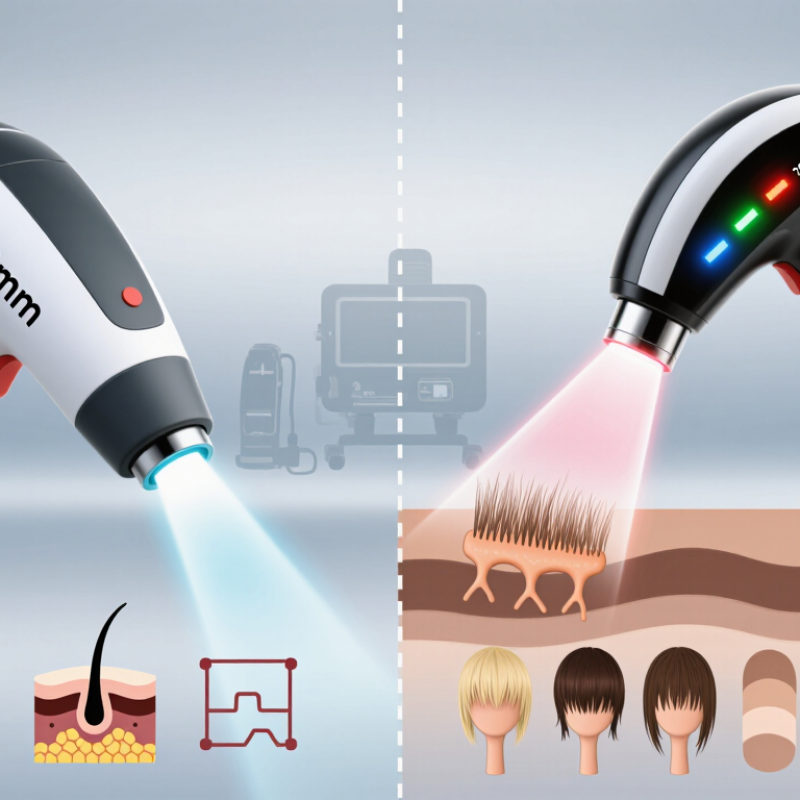
An 808nm diode laser uses one primary wavelength, centered near 808 nanometers. This wavelength is widely associated with hair-reduction treatments because it targets melanin in the hair follicle. It usually offers balanced penetration for many common hair types and skin tones. However, results depend on more than wavelength alone.
A triple wavelength diode laser combines three light ranges, commonly 755nm, 808nm, and 1064nm. Each range behaves differently in the skin. The shorter 755nm wavelength may interact more strongly with lighter, finer hair. The 808nm wavelength provides a practical middle range. The longer 1064nm wavelength generally penetrates deeper and interacts less with surface melanin. This can support treatment planning for darker skin, but it does not remove every safety concern.
The label sounds simple.
In real treatment rooms, device performance also depends on fluence, pulse duration, spot size, cooling, and operator training. A triple wavelength system is not automatically better. An 808nm system may be more predictable for a specific hair and skin combination. Experienced practitioners assess skin response, hair thickness, treatment area, and medical history before selecting settings. Patch testing remains useful, especially when skin is recently tanned or sensitive. I have found that simple comparisons can become misleading. Wavelengths overlap in practice, and individual results vary. Clear records and cautious adjustments are often more valuable than impressive specifications.
A single-wavelength diode laser uses one nominal emission band, while a triple-wavelength system combines 755 nm, 808 nm, and 1064 nm diode wavelengths.
Delivers energy around one established near-infrared wavelength. It is a straightforward configuration with one wavelength range to control.
Combines 755 nm, 808 nm, and 1064 nm. The broader wavelength selection is designed to support treatment planning across different hair and skin characteristics.
The chart compares nominal emission wavelengths only. Actual clinical performance depends on fluence, pulse duration, spot size, cooling, skin type, hair characteristics, and treatment technique.
How 808nm and Triple Wavelength Lasers Work
An 808nm diode laser delivers concentrated energy into melanin within the hair shaft and follicle. Its depth suits many common treatment areas, including legs, underarms, and the bikini line. The heat travels downward, weakening follicular growth while limiting unnecessary surface exposure. Clinical results depend on fluence, pulse duration, cooling, hair thickness, and skin tone. Wavelength alone does not guarantee performance.
Triple wavelength systems usually combine 755nm, 808nm, and 1064nm energy. The shorter 755nm wavelength is strongly absorbed by melanin near the surface. The 808nm wavelength provides balanced penetration. The longer 1064nm wavelength reaches deeper tissue with lower melanin absorption. This layered approach may improve flexibility across different hair depths and skin types, but it can also complicate calibration. More wavelengths are not automatically better.
A 2023 ISAPS Global Survey recorded over 19 million nonsurgical aesthetic procedures worldwide, reflecting strong demand for energy-based treatments. However, broad industry data rarely separates diode wavelengths or confirms long-term hair reduction. That limitation matters. A 2022 review in Lasers in Medical Science reported that repeated diode treatments can produce substantial hair reduction, yet outcomes vary widely between studies. Experienced operators still need patch testing, measured settings, and careful follow-up. The comparison is not perfectly clean.
| Comparison Dimension |
808nm Diode Laser Single-Wavelength Technology |
Triple-Wavelength Diode Laser Typically 755nm + 808nm + 1064nm |
|---|---|---|
| Basic Operating Principle | Emits light centered around 808nm. Melanin in the hair shaft and follicle absorbs the light and converts it into heat, producing selective photothermolysis that damages the follicle while the surrounding skin is protected as much as possible. | Uses three complementary wavelength ranges to target melanin at different depths and with different absorption characteristics. Depending on the equipment, the wavelengths may be delivered sequentially, simultaneously, or through independently controlled treatment modes. |
| Primary Target | Melanin within the hair shaft and follicular structures. | Melanin within the hair shaft and follicular structures, with broader coverage of superficial, intermediate, and deeper follicular regions. |
| Wavelength Characteristics | 808nm provides a widely used balance between melanin absorption and penetration depth, making it suitable for many common hair-removal applications. | 755nm is absorbed more strongly by melanin and is generally more superficial; 808nm provides balanced penetration; 1064nm is absorbed less by epidermal melanin and generally penetrates more deeply. |
| Typical Hair Types | Often effective for coarse or medium brown-to-black hair. Results depend on hair thickness, pigment concentration, growth cycle, skin type, and treatment settings. | Can provide greater flexibility for coarse, medium, and finer pigmented hair because the operator can select or combine wavelengths according to hair depth, thickness, and skin characteristics. |
| Skin-Type Considerations | Can be used across a range of skin tones when the fluence, pulse duration, spot size, cooling, and treatment technique are properly selected. Caution is required for highly pigmented or recently tanned skin. | The 1064nm component is commonly useful when treating darker skin types because it has lower melanin absorption than shorter wavelengths. This does not eliminate risk, and professional assessment and conservative settings remain essential. |
| Depth of Action | Generally reaches the depth of many common hair follicles and is suitable for a broad range of body areas. | Offers a wider depth range: 755nm tends to emphasize more superficial targets, 808nm covers intermediate depths, and 1064nm is generally better suited to deeper follicles. |
| Versatility | Simple wavelength selection makes treatment protocols easier to standardize and may be sufficient for clinics focusing on common hair-removal needs. | Provides more wavelength options for different combinations of skin tone, hair thickness, follicle depth, and treatment area. Greater versatility also requires appropriate operator knowledge and device control. |
| Treatment Customization | Customization is mainly achieved by adjusting fluence, pulse duration, repetition rate, spot size, cooling, and treatment technique. | Customization includes the same treatment parameters plus wavelength selection, wavelength ratio, sequencing, or combined delivery when supported by the equipment. |
| Comfort and Cooling | Comfort depends on energy density, pulse duration, treatment area, hair density, and the quality of epidermal cooling. A warm snapping or prickling sensation is commonly reported. | Comfort also depends on the selected wavelength and parameters. Effective contact, air, or other epidermal cooling is important because shorter wavelengths may interact more strongly with superficial melanin. |
| Expected Treatment Course | Multiple sessions are normally required because laser energy is most effective when hairs are in the active anagen growth phase. Maintenance treatments may be needed. | Multiple sessions are also normally required. A broader wavelength range may improve protocol flexibility, but it does not remove the need to treat hairs during suitable growth phases. |
| Effect on Light or Gray Hair | Limited effectiveness is expected for white, gray, and very light-blonde hair because these hairs contain little or no melanin to absorb the laser energy. | The same fundamental limitation applies. Adding wavelengths does not reliably overcome the absence of sufficient hair pigment. |
| Effect on Very Fine Hair | Very fine hair may respond less consistently because it contains less pigment and absorbs less total energy than coarse hair. | The 755nm component may be useful for some finer pigmented hairs, but response still depends on pigment level, follicle structure, skin contrast, and safe treatment parameters. |
| Safety Factors | Potential adverse effects include temporary redness, swelling around follicles, discomfort, pigmentary changes, blistering, or burns when unsuitable settings or techniques are used. | The same risks apply. Multiple wavelengths do not automatically make a device safer; correct skin assessment, test spots, cooling, parameter selection, and trained operation are essential. |
| Best-Suited Use Case | Suitable for users seeking a focused, established wavelength for routine hair-removal treatments, especially when the target hair and skin profile is relatively consistent. | Suitable for clinics or users seeking broader adaptability across different hair thicknesses, follicle depths, treatment areas, and skin tones within the device’s validated operating range. |
| Main Advantage | Focused design, straightforward protocol development, and a well-established balance between penetration and melanin absorption. | Broader treatment flexibility through complementary wavelength behavior and the ability to adapt protocols to a wider range of hair and skin conditions. |
| Main Limitation | A single wavelength may be less adaptable when hair depth, thickness, or skin pigmentation varies significantly between treatment areas or individuals. | More complex wavelength and parameter management is required. The presence of three wavelengths does not guarantee better results unless the device is properly calibrated and operated. |
| Important Selection Criteria | Consider verified output stability, cooling performance, spot size, pulse control, treatment protocols, operator training, and suitability for the intended skin and hair types. | In addition to those factors, verify the actual wavelength configuration, whether wavelengths are simultaneous or sequential, independent energy control, cooling performance, and validated protocols for the intended users. |
Note: Actual results vary according to hair color and thickness, skin type, hormonal factors, treatment area, device output, cooling, treatment intervals, and operator technique. Laser hair removal is generally described as long-term hair reduction rather than guaranteed permanent removal.
An 808nm diode laser uses a focused wavelength for hair reduction. It is commonly selected for its balance between melanin absorption and follicle penetration. The energy can reach many common follicle depths without excessive surface exposure. However, results depend on hair thickness, skin tone, cooling, and treatment settings.
A triple wavelength diode laser usually combines 755nm, 808nm, and 1064nm energy. Each wavelength interacts with tissue differently. The shorter 755nm wavelength is often more responsive to shallow, finer hair. The 808nm wavelength supports balanced penetration for many treatment areas. The longer 1064nm wavelength generally reaches deeper targets and is often considered suitable for darker skin types when used correctly. Coverage can feel more adaptable across the face, arms, legs, and back.
The difference is not simply “single versus three.” It involves energy delivery, pulse width, spot size, and operator judgment. A wider treatment range may improve flexibility, but it does not guarantee better outcomes. A well-calibrated 808nm system can perform consistently on suitable hair and skin combinations. Triple wavelength treatment may require more careful adjustment between areas.
A simple wavelength comparison can mislead.
Qualified practitioners should assess skin response, hair density, and recent sun exposure before treatment. Patch testing and documented settings add reliability. Even then, outcomes vary. Hair growth cycles are uneven, and some follicles may respond slowly. That limitation deserves honest discussion.
Choosing between an 808nm diode laser and a triple-wavelength system requires more than comparing technical labels. The 808nm wavelength reaches the hair follicle effectively and often provides predictable treatment for medium to coarse hair. Clinical reviews, including findings discussed in Lasers in Medical Science, indicate that long-term hair reduction depends strongly on fluence, pulse duration, cooling, and hair-to-skin contrast. Wavelength alone does not guarantee better results.
Triple-wavelength systems commonly combine approximately 755nm, 808nm, and 1064nm energy. This broader approach may improve flexibility across fine, deep, or differently pigmented hair. The 755nm component targets shallower follicles, while 1064nm generally penetrates deeper with lower melanin absorption. That may support safer treatment for darker skin, when settings are professionally adjusted. The American Academy of Dermatology Association stresses that skin type, medical history, and operator experience influence complication risk.
Comfort remains practical. Proper cooling can reduce the sharp, hot-pin sensation during each pulse. Still, “painless” is an imperfect promise. Some areas feel noticeably warmer, especially around the bikini line or ankles. The U.S. FDA also notes that adverse-event databases cannot calculate true treatment incidence. A 2023 review in the Journal of Cosmetic Dermatology similarly emphasized individualized settings and trained supervision. More wavelengths can help, but they also increase calibration demands. Mismanaged energy remains the real concern.
Choosing a diode laser starts with skin tone, hair pigment, hair thickness, and treatment area. An 808nm system often suits medium to coarse, dark hair on many skin tones. It offers a practical balance between melanin absorption and treatment depth. However, darker skin needs careful energy control and reliable cooling. Comfort matters too.
A triple-wavelength device may combine shorter, middle, and longer wavelengths, commonly around 755nm, 808nm, and 1064nm. The shorter wavelength can target shallower follicles, while the longer wavelength may be safer for deeper follicles and higher-melanin skin. Yet multiple wavelengths do not guarantee better results. Settings must match the client, not the machine label. That distinction is often missed.
In clinical practice, dense black hair usually responds more predictably than blond, red, white, or grey hair. Fine hair may need different pulse duration, spacing, and patience. A qualified practitioner should assess Fitzpatrick skin type, recent tanning, medication history, and hair-growth patterns. Patch testing and documented follow-up improve safety and decision-making. Even then, results vary. Good equipment helps, but skilled adjustment matters more.
It directs concentrated heat into melanin inside the hair shaft and follicle. The heat weakens future growth. Treatment depth suits legs, underarms, and bikini areas. Results depend on settings, cooling, hair thickness, and skin tone.
These systems commonly combine 755nm, 808nm, and 1064nm energy. The shorter wavelength targets shallower follicles. The middle wavelength offers balanced penetration. The longer wavelength reaches deeper tissue with lower melanin absorption.
No. More wavelengths do not automatically produce better results. A triple system may offer broader treatment flexibility. However, calibration becomes more complicated. Skilled adjustment still matters more than labels.
An 808nm system often suits medium to coarse, dark hair. It provides practical follicle depth for many common areas. Dense black hair usually responds more predictably. Individual results still vary.
Yes, but energy control and cooling require careful attention. A longer wavelength may reduce surface melanin absorption. A trained practitioner should assess skin type and recent tanning. Patch testing remains important.
Not always. Proper cooling can reduce the hot-pin sensation. The bikini line and ankles may feel warmer. “Painless” is an imperfect promise. Comfort depends on settings, area, and personal sensitivity.
Blond, red, white, and grey hair may respond less predictably. Fine hair can also require different pulse timing and spacing. Patience helps. Results may remain limited.
A qualified practitioner should review skin type, medication history, tanning, and growth patterns. Patch testing should come first. Settings should be documented. Follow-up helps reveal whether adjustments are needed. The process is not perfectly predictable.
Choosing between an 808nm Vs Triple Wavelength Diode Laser depends on treatment goals, skin type, hair characteristics, and desired coverage. An 808nm diode laser uses a single wavelength that is widely recognized for balanced penetration and effective energy absorption in the hair follicle. A triple wavelength system combines three wavelengths to target follicles at different depths, potentially offering more flexible treatment coverage for varied hair thicknesses and skin conditions.
Both technologies can provide efficient hair removal when used with appropriate settings and professional operating methods. Their main differences involve penetration depth, treatment versatility, comfort, and performance across different body areas. The 808nm option may be suitable for users seeking a focused and straightforward solution, while a triple wavelength laser may be preferable for treating mixed hair types or multiple skin tones. Selecting the right device should involve evaluating follicle depth, hair color and density, skin sensitivity, cooling performance, and operator expertise to support safe, comfortable, and consistent results.

UNT TECH