Choosing a laser wavelength is not a simple contest. The real question is: which technology suits the patient’s skin tone, hair depth, and treatment area?
The topic 755nm Vs 808nm Vs 1064nm Laser Hair Removal deserves careful clinical comparison. The 755nm alexandrite laser is strongly absorbed by melanin, often making it effective for lighter skin and dark, coarse hair. The 808nm diode laser offers balanced penetration and remains widely used across many treatment areas. The 1064nm Nd:YAG laser penetrates deeper and generally presents a safer option for darker skin tones, because it is less strongly absorbed by surface melanin. Results still vary.
No wavelength wins every case.
The American Academy of Dermatology explains that laser hair removal usually requires several sessions and produces long-term hair reduction, not guaranteed permanent removal. Grand View Research also reports continuing expansion in the global laser hair removal market, reflecting rising consumer demand and broader clinical adoption. Market growth, however, does not replace individualized assessment.
Dermatologist Dr. Tina Alster has emphasized, “The best laser is the one that matches the patient’s skin type and hair color.” Her practical point matters. A powerful device can still be poorly selected. I have also found that treatment expectations are often too optimistic, especially when hair is fine, blond, red, or hormonally influenced. This comparison will examine wavelength physics, safety, comfort, treatment speed, and real-world suitability. It will also acknowledge an uncomfortable truth: device labels alone cannot predict every patient’s outcome. Consultation, test spots, trained operators, and consistent aftercare remain essential.
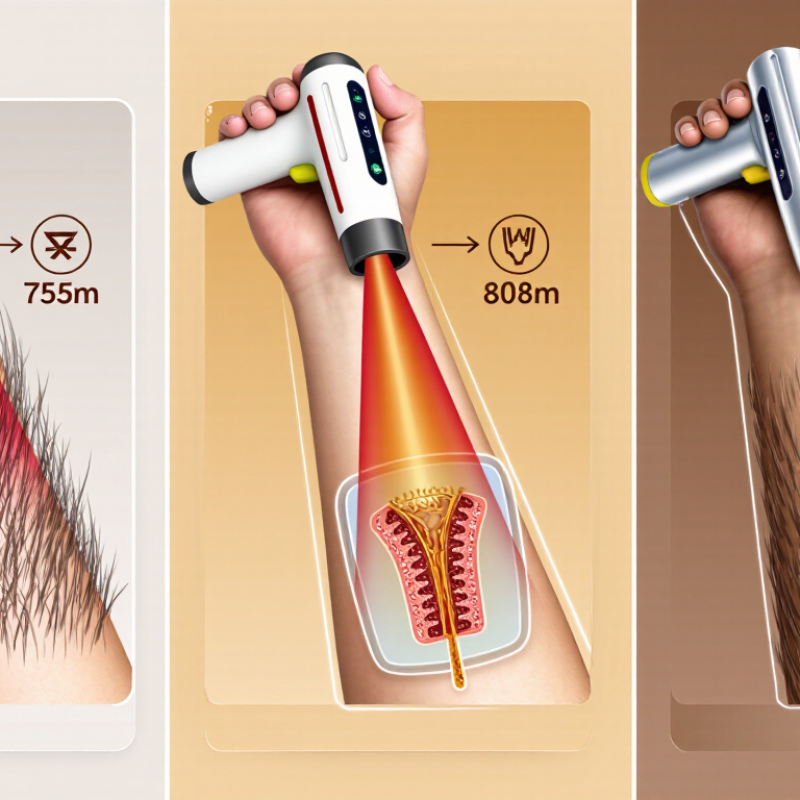
755nm, 808nm, and 1064nm describe the wavelength of light used in laser hair removal. The wavelength affects how deeply energy travels and how strongly melanin absorbs it.
A 755nm wavelength is absorbed efficiently by melanin. It often suits lighter skin with dark, coarse hair, especially on areas such as the legs or underarms. However, higher melanin levels can increase the risk of surface irritation if settings are poorly chosen.
808nm wavelengths offer a balanced penetration depth. Many practitioners use them for common body areas and a range of hair textures. Results still depend on hair thickness, growth cycle, and the contrast between hair and skin.
1064nm reaches deeper into the skin and is absorbed less by melanin near the surface. This can make it a useful option for darker skin tones, when treatment is performed by a trained professional. It is not automatically safer for everyone. Poor cooling or excessive energy can still cause burns or pigmentation changes.
Experience matters. A qualified practitioner should assess your skin tone, recent sun exposure, medication history, and hair pattern before selecting settings. A small patch test can reveal unexpected sensitivity, although it cannot predict every reaction. I have found that people often focus on the wavelength alone, but technique matters just as much. Even the “best” wavelength may perform poorly when hair is too fine, the skin is tanned, or treatment timing ignores the growth cycle.
Choosing between 755nm, 808nm, and 1064nm depends on how each wavelength interacts with hair pigment and skin pigment.
The 755nm wavelength is strongly absorbed by melanin. It can work efficiently on fine, light-colored hair when the skin has lower melanin levels. However, its stronger surface absorption may increase discomfort or pigment changes on darker or recently tanned skin. Experienced practitioners usually adjust energy carefully and use effective cooling.
The 808nm wavelength reaches deeper into the hair follicle. It offers a practical balance between melanin absorption and penetration. Many treatment plans use it for medium to coarse hair across a broad range of skin tones. Results still depend on hair density, growth stage, hormonal factors, and device settings. Darker hair responds more reliably because it contains more pigment.
The 1064nm wavelength penetrates deepest and interacts less with melanin in the outer skin. This can make it a cautious option for deeper follicles or higher-melanin skin types. It may feel warmer, especially on coarse hair. Individual response varies.
Hair must be present.
A qualified provider should assess skin tone, hair thickness, recent sun exposure, and medical history before treatment. A patch test can reveal unexpected irritation, although it cannot predict every reaction. I have seen people focus only on wavelength and overlook cooling, pulse duration, and operator technique. That is a mistake. Safe treatment requires regular progress checks, realistic expectations, and protection from sun exposure.
Choosing 755nm, 808nm, or 1064nm depends mainly on skin tone, hair pigment, and hair thickness. The wavelength label alone cannot predict results. A 755nm alexandrite wavelength is strongly absorbed by melanin, making it effective for dark hair on fair to light-medium skin, commonly Fitzpatrick I–III. However, tanned or deeply pigmented skin needs greater caution because the epidermis also contains melanin.
An 808nm diode wavelength offers a practical middle ground. It usually suits Fitzpatrick I–IV skin and coarse brown or black hair. Its deeper penetration can support treatment on legs, arms, and larger areas. Still, “universal” is an overstatement. Treatment settings, cooling, and pulse duration can change comfort and outcomes. A clinical review in Lasers in Medical Science reported that darker, thicker hair generally responds better than fine hair across laser types.
The 1064nm Nd:YAG wavelength penetrates deeper and is absorbed less by surface melanin. Professional dermatology guidance commonly considers it the safer option for Fitzpatrick V–VI skin, especially when hair is coarse and dark. It may need more sessions for fine hair. Blonde, red, gray, and white hair often respond poorly because they contain limited target pigment. A 2023 review in Dermatologic Surgery also emphasized that hair reduction varies widely between patients, so percentage claims should be treated carefully. Skin assessment matters more than marketing promises.
| Comparison Factor | 755nm | 808nm | 1064nm |
|---|---|---|---|
| Common laser type | Alexandrite-type wavelength | Diode-type wavelength | Nd:YAG-type wavelength |
| Primary melanin absorption | Higher absorption by melanin | Moderate absorption by melanin | Lower absorption by melanin |
| Typical penetration profile | Relatively shallow to moderate penetration; effective for follicles closer to the surface | Moderate penetration and balanced follicular heating | Deeper penetration with less energy absorbed by surface melanin |
| Best-suited skin tones | Usually light to medium-light skin tones, particularly when the skin is not recently tanned | Light to medium skin tones; settings must be adjusted carefully for darker skin | Medium-brown to deep-brown skin tones, including many Fitzpatrick V–VI patients, when performed by a trained professional |
| Use on dark or recently tanned skin | Higher risk of epidermal pigment changes because melanin absorbs more energy; generally requires greater caution | Possible in selected cases with conservative parameters and appropriate cooling | Generally preferred for darker or tanned skin because it produces less superficial melanin absorption, although risk is not eliminated |
| Best-suited hair colors | Black to dark-brown hair; may perform well on some medium-brown hair | Black to dark-brown hair; often suitable for coarse, dense hair | Black to dark-brown hair; may be useful for deeper or coarse follicles |
| Very light, red, gray, or white hair | Usually limited results because these hairs contain too little pigment | Usually limited results because the target is melanin in the hair shaft and follicle | Usually limited results; the longer wavelength does not compensate for absent or very low hair pigment |
| Typical strength | Often effective for lighter skin with dark hair and can provide strong follicular absorption | Versatile balance of penetration, melanin absorption, treatment speed, and comfort | Improved safety margin for darker skin and deeper follicles when correct parameters are used |
| Relative pigment-change concern | Higher on darker or tanned skin | Moderate; depends strongly on settings and cooling | Lower than 755nm for darker skin, but burns and pigment changes remain possible |
| Relative treatment comfort | Often described as sharper or more intense, especially on dense hair | Generally moderate; integrated cooling can improve comfort | May feel deeper or more intense because of the energy and pulse settings required |
| Common treatment areas | Face, underarms, bikini area, legs, and other areas with dark hair on suitable skin tones | Face and body, including larger areas such as the legs, back, and chest | Face and body, especially areas with coarse or deeper hair and darker skin types |
| Most appropriate choice when | The skin is relatively light and the hair is dark, coarse, and clearly pigmented | A balanced option is needed for light to medium skin with dark hair, subject to professional assessment | Skin is medium-brown to deep-brown, or there is a higher concern about superficial melanin absorption |
| Important limitation | Not automatically the fastest or safest option for every light-skinned person; tanning and skin sensitivity matter | “808nm” devices can differ in pulse width, fluence, spot size, and cooling, so wavelength alone does not determine results | Lower melanin absorption can also mean less efficient heating of some fine or lightly pigmented hair |
General guidance: Laser hair removal works best on actively growing, pigmented hair, especially black or dark-brown hair. No listed wavelength reliably removes white, gray, or very blonde hair because these hairs contain little or no melanin. The safest and most effective choice depends on skin tone, tanning status, hair thickness, treatment area, pulse settings, cooling, and professional evaluation. A patch test is recommended before a full treatment.
Choosing 755 nm, 808 nm, or 1064 nm depends on skin tone, hair thickness, and treatment settings. The 755 nm wavelength is strongly absorbed by melanin, often making it effective for coarse, dark hair on lighter skin. However, that same absorption can increase heat in surrounding skin, causing sharper discomfort or temporary redness. The 808 nm diode wavelength offers a practical middle ground. Clinical reviews report substantial reduction after several sessions, commonly around 60–80%, although results vary by body area and hormonal status.
The 1064 nm wavelength penetrates more deeply and interacts less with epidermal melanin. This makes it a widely considered option for darker skin tones, where excessive surface heating may increase pigmentation risks. A 2019 review in Dermatologic Surgery reported long-term hair reduction commonly ranging from 50–80% across laser systems, not a guaranteed permanent result. Cooling, pulse duration, and fluence matter as much as wavelength. Sometimes, the operator matters more.
Comfort is personal. A 755 nm session may feel like quick rubber-band snaps, while 808 nm often feels warmer and broader. The 1064 nm pulse can feel deeper, especially on dense hair. Poor settings can cause burns, blistering, or pigment changes with any wavelength. Patch testing and documented skin assessment remain essential. I would not call one wavelength universally safest; that claim oversimplifies real clinical practice. Forgotten details, such as recent tanning or medication use, can change the risk profile.
Evidence-informed comparative index: higher values indicate a stronger relative advantage for the stated factor. Results vary with skin tone, hair color, fluence, cooling, and treatment settings.
The 755nm wavelength is strongly absorbed by melanin and is often effective for light skin with dark hair, but requires greater caution with tanned or darker skin. The 808nm diode wavelength offers a balanced option across many skin types. The 1064nm Nd:YAG wavelength is absorbed less by epidermal melanin, generally improving safety for darker skin, although it may require more treatments or higher settings for comparable hair reduction. Professional assessment and appropriate cooling are essential for all wavelengths.
Choosing between 755nm, 808nm, and 1064nm should begin with your skin tone, hair characteristics, and treatment area. A qualified practitioner should assess all three before selecting settings. Skin changes with seasons, tanning, and hormones, so one wavelength may not suit every appointment.
The 755nm wavelength is strongly absorbed by melanin. It can work well on lighter skin with fine or medium hair, especially on smaller areas. However, darker or recently tanned skin may need greater caution because the surrounding skin contains more pigment. The 808nm wavelength offers a balanced option for many skin and hair types. It reaches the follicle effectively and often suits medium to coarse hair on larger areas, such as legs or the back.
The 1064nm wavelength penetrates more deeply and interacts less with surface melanin. Practitioners may prefer it for darker skin tones or deeper, coarse follicles. It can feel different, and results may appear slower on fine hair. Treatment comfort also depends on cooling, pulse settings, and the operator’s technique. Ask for a consultation and a patch test. Small details matter. Never judge safety by wavelength alone. Poor settings can irritate skin, while conservative settings may produce limited results. Hair growth cycles vary, too, so several properly spaced sessions are normally needed. Even experienced professionals must adjust their plan when the skin or hair responds unexpectedly.
It is strongly absorbed by melanin in the hair. It can work efficiently on fine, light-colored hair and lighter skin. Surface absorption may increase discomfort on darker or recently tanned skin. Cooling and careful energy control matter.
The 808nm wavelength reaches deeper into the follicle. It offers a practical balance between absorption and penetration. Many plans use it for medium or coarse hair across varied skin tones. Darker hair usually responds more reliably.
The 1064nm wavelength penetrates deepest into the skin. It interacts less with melanin near the surface. This may suit deeper follicles or higher-melanin skin types. The pulse can feel warmer on dense, coarse hair.
No wavelength is universally safest. Skin tone, tanning, hair thickness, cooling, pulse duration, and energy settings all affect risk. Poor settings can cause burns, blisters, redness, or pigment changes. That answer is less simple than it sounds.
A 755nm treatment may feel like quick rubber-band snaps. An 808nm treatment often feels warmer and broader. A 1064nm pulse may feel deeper, especially with dense hair. Comfort varies.
Several sessions may produce substantial hair reduction, often around 60–80%. Results differ by body area, hair density, growth stage, and hormonal factors. Long-term reduction commonly ranges from 50–80% across systems. Permanent results should not be promised.
Darker hair contains more pigment and often responds more reliably. Fine or light-colored hair may require careful assessment. Hair must be present. Focusing only on wavelength can create unrealistic expectations.
A qualified provider should assess skin tone, hair thickness, recent sun exposure, and medical history. A patch test may reveal unexpected irritation. It cannot predict every reaction. Recent tanning should not be treated as a minor detail.
Cooling, pulse duration, energy level, and operator technique strongly influence treatment safety. Regular progress checks are important. Sun protection also reduces avoidable pigment risks. Settings matter too.
Not necessarily. Deeper follicles, dense hair, lighter skin, and higher-melanin skin may require different considerations. Individual response varies across the body. A single universal choice sounds convenient, but it may be wrong.
Choosing between 755nm Vs 808nm Vs 1064nm Laser Hair Removal depends on your skin tone, hair color, treatment area, and comfort preferences. The 755nm wavelength is highly absorbed by melanin, making it effective for lighter skin and fine, dark hair, although it requires careful settings on tanned or deeper skin. The 808nm wavelength offers balanced penetration and melanin absorption, making it a versatile option for many skin types and body areas. The 1064nm wavelength penetrates deeper and is absorbed less by surface melanin, so it is often considered more suitable for darker skin tones, especially when professional adjustments are used.
All three wavelengths work by delivering heat to the hair follicle while protecting surrounding tissue as much as possible. Effectiveness depends on the contrast between hair and skin, the growth cycle, treatment consistency, and proper device settings. Comfort and safety can also vary, so a qualified professional should assess your skin and hair before treatment. There is no single best wavelength for everyone; the most appropriate choice is personalized to your needs.

UNT TECH